Understand first. Build in stages you can trust.
We don't begin with a technology choice. We begin with how the work actually happens today, then shape a system around it, built and shown to you in stages, not delivered as one surprise at the end.
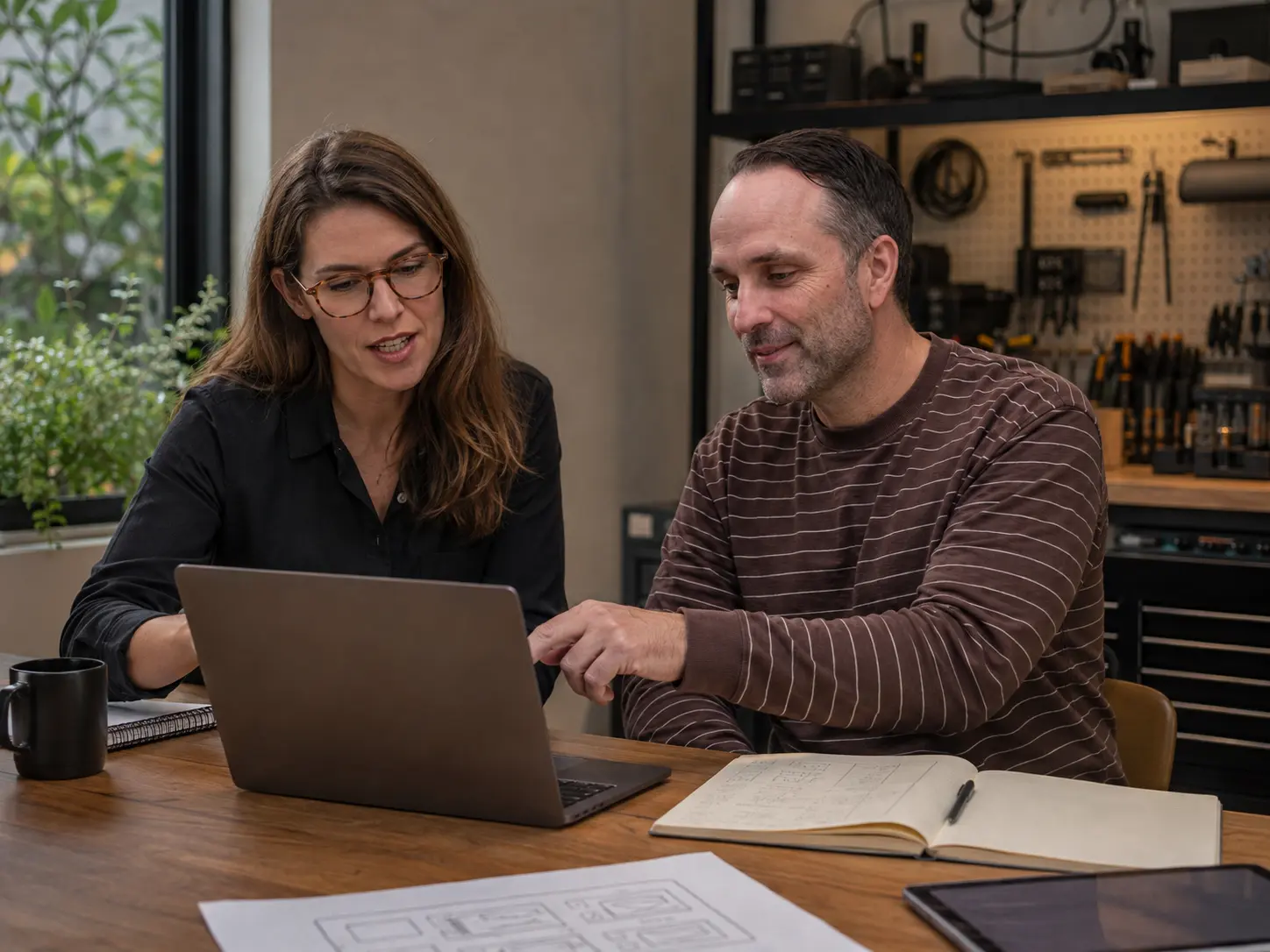
You don't need a finished brief
Most engagements begin somewhere messier than a scoped brief. That's what the first stage is for, turning any of the below into a plan worth building.
Five stages, one continuous loop
This isn't a rigid waterfall, and it isn't "move fast and see what breaks." It's a disciplined loop: understand deeply, target the highest-value change, shape the system properly, ship in increments, then observe and improve once it's in real use.
Understand the business
Find the highest-value intervention
Shape the system
Build in working increments
Launch, observe and improve
What guides the decisions in between
A process describes the stages. These are the judgement calls we make inside them.
Problem before technology
We start with the business problem, not a preferred stack. We won't prescribe a technology until we understand how the work actually flows, and once we do, we pick whichever tool genuinely fits, not the one we'd rather use.
Built in the open
You stay close to the build the whole way through, and you see working software early rather than waiting for a reveal. When something is uncertain, or trades one thing off against another, we say so plainly.
Yours to keep
We favour clear systems over clever ones, and build for the person who has to maintain this after we've moved on. That means no unnecessary dependency on us, and no complexity you'll later have to pay to unwind.
AI helps us build faster. It doesn't lower the bar.
We use AI-assisted engineering internally, for drafting, scaffolding, and moving faster through the mechanical parts of a build. Every line that ships is still reviewed against the same standard a person would be held to: does it work, is it secure, will someone else be able to maintain it.
Security, data handling and permissions aren't bolted on before launch. They're a design requirement from the first conversation about how the system should work.
Work with us the way that fits
A focused website is the work we have the most capacity for right now. Larger operational systems are delivered in controlled stages. For APRA-regulated or high-risk enterprise work, we partner with Adaptation.ai.
Discovery & solution shaping
A short, focused engagement to properly understand a problem and agree the right approach, before anything gets built.
Focused build
One well-defined system or feature, scoped clearly and delivered as a single project.
Product or platform delivery
A larger platform, portal or product, planned and built in stages through to launch.
Improving an existing system
Working out what's actually not working in a system you already have, then fixing or extending it rather than replacing it outright.
Eagle Care
After launch: professional hosting, reasonable site updates (including agent-assisted changes), and ongoing SEO and AEO work. Higher plans on request.
Advisory & technical direction
A second opinion on a plan, input on a decision, or hands-on technical direction without a full build attached.
Not sure which of these fits your situation?
That's a normal place to start. Tell us what you're dealing with and we'll help work out the right way in.